
Different types of wallpaper: which one suits you?
Ten types of wallpaper at the DIY store and no idea which one fits your new build or renovation? Expert advice per situation, target group and budget.
You're standing in front of the wall and have no idea where to start
Whether you've just received the keys to a new build, bought a house that needs some work, or are simply ready for a fresh look after years of the same walls: the choice in wallpaper is overwhelming. Non-woven wallpaper, paper wallpaper, renovlies, glass fleece, glass fibre weave, vinyl, photo wallpaper. Every type has its own properties, its own price and its own pitfall.
We get asked every week: "Which wallpaper do I need?" The honest answer is that it depends on your wall, your situation and what you expect in five years. Below we run through the most important types from the perspective of someone who applies them every day.
Which wallpaper suits which situation?
A practical rule of thumb:
- New build with fresh walls that are still drying and shrinking: renovlies. It bridges the small cracks that would otherwise become visible within the first year.
- Renovation of an old wall with dents, cracks or old paint layers: renovlies in a thicker variant (180 or 200 grams).
- High-traffic space such as a hallway, office or stairwell: glass fibre weave or glass fleece, extra impact resistant.
- Accent wall in a bedroom or living room: a decorative non-woven or vinyl wallpaper, optionally with a print.
Renovlies wallpaper
Renovlies is made from cellulose and textile fibres (no glass) and is designed to bridge small imperfections and shrinkage cracks. The result looks like plastered walls, but at a lower cost. Renovlies is strong, paintable and, unlike glass fibre, it does not release irritating particles while you work.
Want to know which grams per m² suits your situation? Read our guide renovlies thicknesses. Not sure whether to choose renovlies or plastering? Our comparison renovlies or plastering will help you decide.
Glass fibre weave wallpaper
Glass fibre weave is woven from glass fibres, making it extra robust. You'll find it a lot in offices, schools and hospitality venues: impact resistant, fire retardant and paintable. It works fine in homes too, but there is one downside: during application, microscopically small glass particles are released. These can cause significant itching and are not ideal in a home with young children or people with sensitive skin. In almost all residential situations we therefore recommend renovlies. It gives the same clean end result without the irritation.
Glass fleece wallpaper
Glass fleece is the thinner sibling of glass fibre weave. It is made by drawing molten sand into thin threads and pressing them into a smooth strip. Glass fleece has a clean, professional look and is excellent for painting over. It is slightly less effective at bridging cracks than renovlies and is cheaper. A good choice if your budget is tight, but for most new build situations we would still recommend renovlies. Read glass fleece wallpaper compared for a detailed comparison.
Paper and non-woven wallpaper with a print
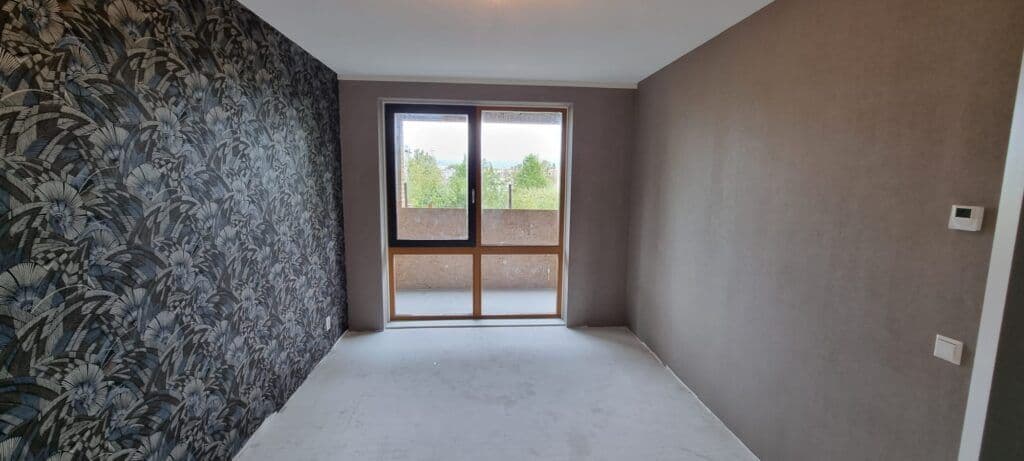
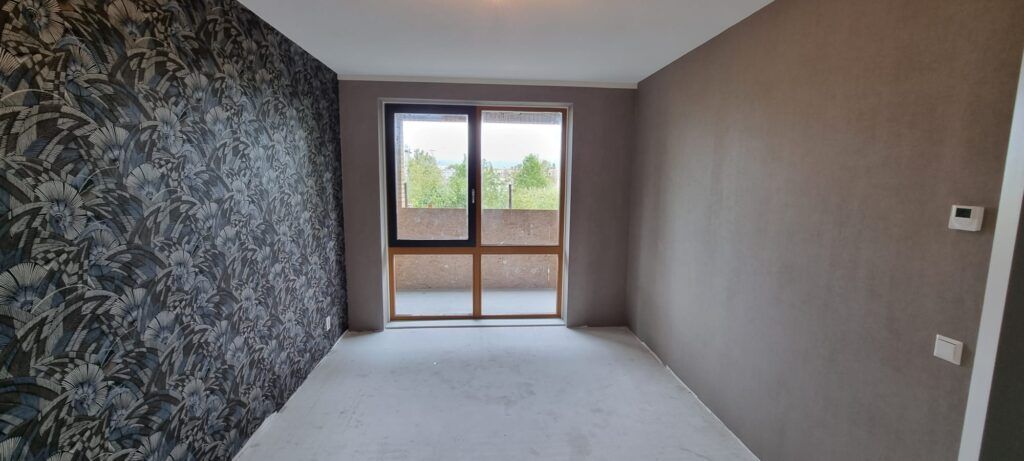
Classic wallpaper with a pattern or print is far from gone. It is actually making a comeback. With a non-woven backing, the strips are dimensionally stable and fairly easy to apply. Keep in mind that this wallpaper does not bridge cracks: shrinkage cracks beneath the strip will become visible sooner or later. For an accent wall on an already smooth surface this is fine, but not for an entire new build home.
Vinyl wallpaper
Vinyl wallpaper has a washable plastic layer, handy in a kitchen or bathroom. It is robust, easy to keep clean and available in many patterns. The downside: vinyl does not breathe, so in a damp room without good ventilation, mould can develop behind the strip. That is why we rarely use vinyl in a new build home. We more often work with renovlies and removable latex, which does breathe and is still easy to clean.
Photo wallpaper
Photo wallpaper transforms one wall into a real eye-catcher. On a non-woven backing it is fairly easy to apply and you can have almost any image printed to size. Our tip: use photo wallpaper only on a wall that would otherwise stay bare, and make sure the surface is perfectly smooth first. Every imperfection is amplified by the print.
Which one will you choose?
Still not sure which type of wallpaper suits your home? At Renovlies.net we come by free of charge to assess the walls. One team fills, sands, wallpapers and paints. No switching between tradespeople, no disputes over responsibility, with a 100% coverage guarantee on the end result.
Request a no-obligation quote and choose the wallpaper that suits you with confidence.